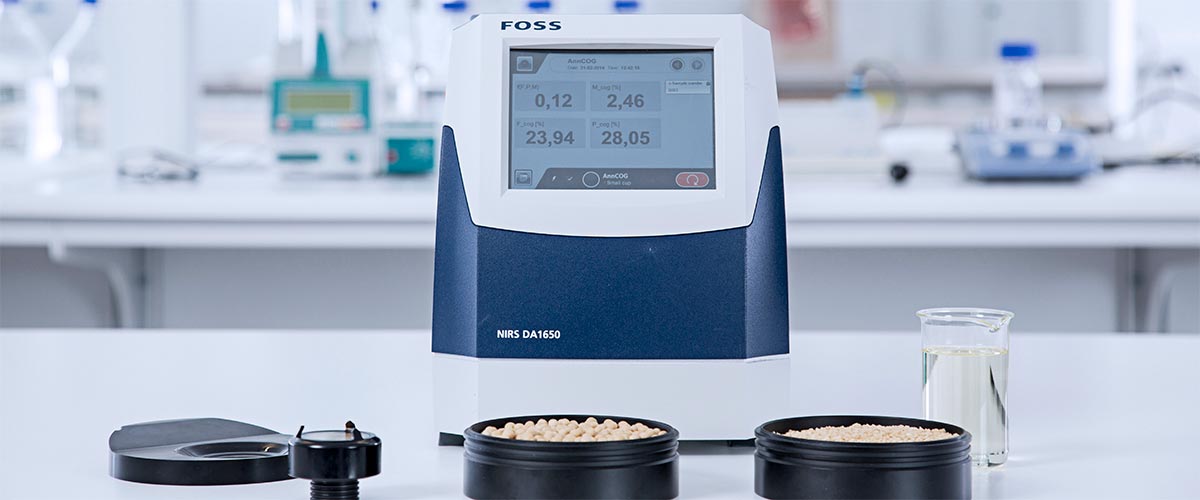
Quality control plays an important role in every stage of the production of maize products, from intake to packing.

Let’s examine oil (fat) and fibre content testing.
Oil (fat) and fibre content
The oil (fat) and the fibre content of the maize products should be tested on a regular basis because:
- The oil content gives the miller an indication of how much of the oil – found in the germ of the maize kernel – has migrated into the endosperm.
- The fibre content gives an indication of the amount of bran contamination present in the finished product.
There are specifications for the maximum and minimum levels of oil and fibre in all maize products.
Unfortunately, the standard test method requires a lot of time as well as a full time laboratory assistant to perform them. But there are machines available to perform these tests in a matter of minutes.

NIR MACHINES
Near Infrared Reflectance (NIR) type machines are the most popular meal testing apparatus in use today. There are a number of models on the market; two of the better-known brands are Perten and FOSS.
These machines aren’t cheap, but are handy when technical products such as maize grits are produced, and fat and fibre content is crucial to the product. Other tests, such as moisture and protein, can also be measured on these machines.
Millers who consider buying a NIR machine should consider the following:
- Is the machine one of the types in use in other mills?
- Does the supplier of the NIR machine have a reliable service technician?
- In order to produce reliable results, the NIR machine must be regularly calibrated – at least twice a year.
- When the NIR machine was initially calibrated, say for meal moisture, a whole range of samples with differing moisture levels were tested using the long method. These results were then inputted into the NIR machine.
NIR TESTING PROCEDURE
A sample of meal is compressed lightly into a glass cell and exposed to a light source which gives out near infrared radiation. The light reflected from the cell is analysed for the characteristic associated with oil or fibre content. These are presented directly as a percentage oil or fibre.
Frequency of testing: At least every two hours.
Images courtesy of https://www.fossanalytics.com/