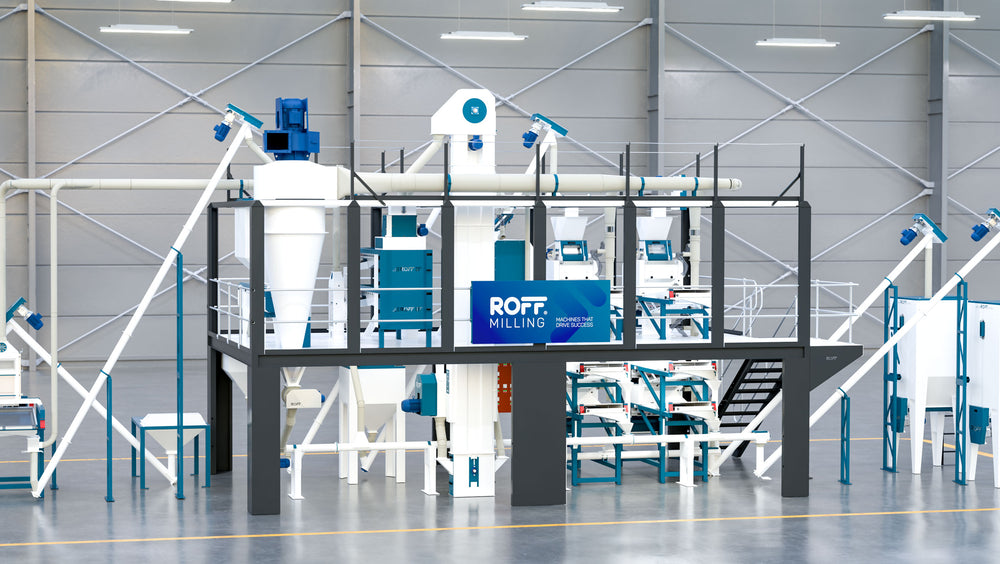
The key to better profit – how to measure, control and improve extraction without compromising maize meal quality.
In short
- Extraction rate is how much valuable maize meal you recover from the maize entering the milling process.
- Good extraction means good separation: maximum recovery of clean endosperm with minimum losses into the chop.
- A small improvement in extraction can make a large difference to profit.
- Milling gain is the additional saleable mass created by moisture retained during conditioning.
- The miller makes the difference. Even the best equipment requires correct settings, regular measurement and attention to product quality.
1. The basics – What is extraction rate?
A maize kernel consists of three main parts: the endosperm, bran and germ.
The endosperm is the white, starchy part of the kernel and makes up approximately 84% of the maize. This is the valuable material used to produce maize meal, samp, maize rice and grits. The bran is the outer covering, while the germ contains most of the maize oil. During milling, the bran and germ are separated from the endosperm and generally sold as the lower-value by-product called chop or offal.
Extraction rate measures how much of the maize is recovered as saleable meal and other valuable endosperm products – at the quality your customer expects.
That last point matters. A mill producing refined super maize meal will normally achieve a lower extraction rate than one producing a less-refined roller meal, because more bran and germ must be removed to achieve the required quality.
The objective is not simply the highest possible extraction number. It is the maximum recovery of clean endosperm while still meeting the required product quality.
2. The money – Why does extraction determine your profit?
Maize is your raw material, but maize meal is where you add value. Bran and chop are necessary by-products, but they are sold for far less than maize meal.
| 72% extraction | 75% extraction | |
|---|---|---|
| Clean maize processed | 1,000 kg | 1,000 kg |
| Maize meal produced | 720 kg | 750 kg |
| Additional maize meal | – | 30 kg |
All examples are illustrative; check them against your own figures.
By improving extraction from 72% to 75%, you produce 30 kg more valuable maize meal from the same ton of maize. You have already purchased, transported, cleaned and processed the maize. The improvement comes from recovering more endosperm that would otherwise have been lost into the chop.
Electricity, labour and maintenance matter, but maize is normally the largest cost in the process. Before trying to save small amounts elsewhere, make sure you are not losing valuable maize meal in your chop.
Extraction rate is not simply a milling number. It is a profit number.
3. What determines a good extraction rate?
Your maize
Kernel hardness, variety, growing conditions and drying methods all influence how easily the endosperm separates from the bran and germ. Even the best mill and miller must work within the limits of the maize being processed.
Conditioning
Conditioning means adding a controlled amount of water to the maize and allowing sufficient time for it to take effect before milling. The water helps loosen the bran from the endosperm and makes the bran more flexible, allowing it to peel away in larger pieces rather than breaking into small fragments. Correct conditioning also helps the germ separate more cleanly from the endosperm.
Too little conditioning causes bran and germ to break up and contaminate the maize meal, while valuable endosperm can be lost into the chop. Too much conditioning, or excessive moisture penetration into the endosperm, can reduce milling performance and create excessive moisture in the finished meal. The miller must therefore control water addition, maize flow and conditioning time according to the maize being processed.
Degermination
Degermination removes the germ and part of the bran before the endosperm reaches the roller mills. Correct conditioning allows the degerminator to remove bran and germ more cleanly, leaving as much valuable endosperm intact as possible. Removing the germ also improves shelf life because the germ contains oil that can cause maize meal to spoil sooner.

Your plant and your miller
A good maize mill is not simply a collection of machines. It is a well-designed process in which cleaning, conditioning, degermination, roller milling, sifting and aspiration work together. But even a quality mill, such as a Roff mill, cannot achieve its full potential without a competent miller.
The miller must adjust conditioning, machine feed rates, roller gaps, sifting and aspiration to suit the maize and keep the process in balance. Poor settings send valuable endosperm into the chop or allow bran to contaminate the maize meal.
Good extraction comes from suitable maize, a good milling process and a miller who knows how to optimise it.
4. Measuring extraction correctly
There are three important measurements that should not be confused.
A. Screenings: Measuring raw material quality
Screenings removed in the pre-cleaner or cleaning room are primarily an indication of the quality of the maize purchased, not the extraction performance of the milling process. Around 2% screenings can be used as an illustrative planning allowance, although actual percentages depend on maize quality and purchasing specifications.
Screenings must be weighed and recorded. They should also be inspected to ensure that good maize is not being unnecessarily removed by poorly adjusted cleaning equipment. For measuring milling performance, the correct starting point is clean maize after screening and before conditioning. In this guide, clean, dry maize means maize before additional conditioning water is introduced.
B. Miller’s spot check: Your speedometer
The Miller’s spot check is a quick measurement that tells the miller what the process is doing right now. While the mill is running steadily, collect the maize meal and chop simultaneously from all relevant finished-product outlets for a fixed period, normally 60 to 120 seconds. Weigh the collected products and calculate their hourly production rates.
| Product | Measured capacity | Share of output |
|---|---|---|
| Maize meal | 700 kg/h | 70% |
| Chop | 300 kg/h | 30% |
| Total | 1,000 kg/h | 100% |
The miller can immediately see that 70% of the outgoing product is maize meal and 30% is chop. This is a useful indication of current performance, but it is not the final extraction rate against clean maize input because conditioning water and other mass changes are not included.
The Spot check tells you what is happening right now and allows you to respond immediately. Perform this check regularly, at least once a day and after significant process changes.
C. Miller's Shift Report
The Miller’s Shift Report measures the actual performance of the mill over a complete production period. It records maize received, screenings removed, clean maize processed, conditioning water added, finished products produced and any process losses. For Roff Technical Extraction Measurement, the key starting point is the mass of clean maize entering the milling process before conditioning.
Maize meal extraction (%) = Net maize meal produced ÷ Clean maize processed × 100
Chop/bran yield (%) = Net chop produced ÷ Clean maize processed × 100
Milling gain should be recorded separately. Unlike the Miller’s spot check, this report measures actual output against the clean maize input over the full shift.
For the most accurate result, measure the process on an empty-to-empty basis. The mill starts with no product in the process, all maize entering is measured, and all finished products leaving the mill are measured until the system is empty again. A full-to-full basis can also be used as a practical balancing method, where conditioning bins and process bins are at the same known full level at the start and end of the measurement period. This is less exact than empty-to-empty, but still useful if stock levels are controlled carefully.
In larger mills, automatic process weighers can be installed on the main product streams. These continuously measure maize input, meal output and chop output, making it easier to compile accurate shift reports and monitor performance over time.
5. A practical extraction calculation
Consider a mill processing 10,000 kg of clean maize during a production period. The following simplified example demonstrates how to calculate extraction, chop yield and milling gain.
| Description | Mass | Percentage |
|---|---|---|
| Maize received before cleaning | 10,200 kg | 100% |
| Screenings removed | 200 kg | 1.96% of receipts |
| Clean maize to the mill | 10,000 kg | 100% milling basis |
| Conditioning water added | 350 kg | 3.5% |
| Maize meal produced | 7,500 kg | 75.0% extraction |
| Chop produced | 2,800 kg | 28.0% |
| Total saleable output | 10,300 kg | 103.0% |
| Illustrative evaporation / process difference | 50 kg | 0.5% |
| Net milling mass gain | 300 kg | 3.0% |
Example assumptions: no stock movements or rework, with 50 kg lost through evaporation during the process. All product percentages use 10,000 kg of clean maize as the denominator. In practice, every unexplained balance difference must be investigated. All examples are illustrative; check them against your own figures.
What does this tell us?
- Extraction rate: 7,500 / 10,000 x 100 = 75%
- Chop yield: 2,800 / 10,000 x 100 = 28%
- Net milling gain: (10,300 – 10,000) / 10,000 x 100 = 3%
Notice that extraction and chop yield add up to 103%, not 100%. This is possible because water has been added during conditioning. It is also why Spot Check and Shift Report percentages are not directly interchangeable.
What exactly is milling gain?
Milling gain is the additional product mass obtained through moisture retained during the milling process. For example, increasing 10,000 kg of maize from 11% to 14% moisture, assuming no solids or water losses, requires approximately 349 kg of additional water and produces a theoretical mass gain of about 3.49%. The increase from 11% to 14% moisture is three percentage points, not a 3% increase in total mass.
In practice, some water evaporates during milling, so the actual gain must be established from the mass balance and checked against finished-product moisture measurements. Conditioning can create additional saleable mass, but milling gain must never come at the expense of product quality or shelf life. Always work to the legal and customer moisture specification applicable to the finished product in your market.
6. What can your offal tell you?
Your chop is one of the best indicators of how effectively your mill is separating the maize. A good milling process produces bran in relatively large, clean pieces, with very little white endosperm still attached. Poor conditioning or incorrect machine settings often produce broken bran, small endosperm particles and pieces of bran with valuable endosperm still attached. This is valuable maize meal being lost into a lower-value product.

Photos from Roff's 2026 conditioning samples.
The miller does not need a sophisticated laboratory to recognise these differences. Take samples from the degerminator, roller mill passages, sifters, aspirators and final chop outlet. Place them in labelled sample trays or on a sample board where they can be compared. A few minutes inspecting these samples can reveal problems that are costing the mill money every hour.
Clean-looking chop is encouraging, but the extraction calculation and finished-product quality tests must confirm the result.
7. What is a good extraction rate?
There is no single extraction percentage that is correct for every maize mill. The achievable rate depends on maize quality, the product grade, the milling process and the required fineness of the finished maize meal.
The following are indicative Roff extraction ranges for common African maize meal grades. They are guidance for suitably configured processes, not guaranteed results for every maize batch.
| Country / Region | Refined maize meal | Less-refined / roller meal |
|---|---|---|
| South Africa, Botswana, Namibia, Lesotho, eSwatini, Mozambique | Super: 70–74% | Special: 80–85% |
| Zimbabwe | Super refined: 73–75% | Super roller: 80–85% |
| Zambia | Breakfast: 75–78% | Super roller: 80–85% |
| Malawi | Super cream of maize: 75–78% | Cream of maize: 80–85% |
| Tanzania | Sembe: 70–74% | Dona: 80–85% |
| DRC | Breakfast: 75–78% | Super roller: 80–85% |
| Kenya | Grade 1 sifted: 75–80% | Sifted: 80–85% |
Indicative ranges drawn from Roff product guidance. Actual performance depends on maize characteristics, specific mill configuration, product specifications and the reporting basis used.
Do not compare a super maize meal mill against a mill producing roller meal. They are making different products. Instead, compare your performance against the correct range for the grade you are producing.
A correctly designed Roff process has the equipment needed to achieve good separation. If extraction remains consistently below its appropriate target, the miller should investigate the reason rather than simply accept poor performance.

8. The miller's extraction checklist
When extraction drops, work through the following checks in order:
| Check | What should the miller look for? |
|---|---|
| 1. Maize quality | Has kernel hardness, moisture or the maize supplier changed? |
| 2. Cleaning | Are impurities being removed without losing good maize in the screenings? |
| 3. Conditioning | Is water flow correct, is mixing consistent, and has the maize rested for the required time? |
| 4. Degermination | Is the feed rate correct? Are the screens and machine settings producing clean separation without breaking excessive endosperm? |
| 5. Offal inspection | Is there visible white endosperm, excessive fine material or bran with endosperm still attached? |
| 6. Roller mills | Are the roller gaps, feed distribution and fluting condition correct? Is the stock being ground to the required particle size? |
| 7. Sifting and aspiration | Are sieve covers clean and undamaged? Are aspirators removing bran without carrying good endosperm into the chop? |
| 8. Finished meal quality | Are moisture, granulation, specks and oil/fat content within the required specifications? |
After making an adjustment
- Change one setting at a time, where practical, so that you can identify what caused the improvement.
- Allow sufficient time for the adjusted product to pass through the process.
- Perform another Miller’s spot check.
- Check the chop and finished maize meal quality again.
- Record the result and retain the best settings for that maize type.
Do not simply close the roller gaps to increase extraction. You may increase the quantity of meal while damaging separation and final product quality.
The correct adjustment improves extraction and maintains quality.
9. Keep a record – Every shift
A good miller does not rely on memory or guesswork. Each shift should record the information needed to measure production, identify losses and track changes over time.
| Measurement | What to record |
|---|---|
| Raw maize | Quantity received, moisture and screenings percentage |
| Clean maize | Actual mass fed into the milling process |
| Conditioning | Water addition, moisture measurements and conditioning settings |
| Maize meal | Net quantity produced by product grade |
| Chop | Net quantity produced |
| Extraction | Percentage against clean maize input |
| Milling gain | Net mass gain and moisture balance |
| Product quality | Moisture, granulation, specks and other grade-specific tests |
| Operations | Spot checks, stoppages, equipment faults and adjustments |
Moisture should be checked regularly on incoming maize, conditioned maize and the finished products. Finished-product quality checks should be completed at least twice per shift, or more frequently where necessary.
Record the extraction rate throughout the shift and compare the final Shift Report with expected performance. Management should review the results over weeks and months. A single poor shift may be caused by a particular batch of maize, but a continuing downward trend is a warning that something in the process needs attention.
Measure it, record it, adjust it and measure it again.
10. The golden rule of extraction
A profitable maize mill is not necessarily the one producing the greatest percentage of maize meal. It is the one that recovers the maximum amount of valuable endosperm while consistently producing the grade and quality that customers are willing to pay for.
Good equipment gives the miller the opportunity to achieve excellent results. Good operating practices turn that opportunity into profit.
Do not chase extraction at the expense of quality. Recover as much clean endosperm as possible in the grade your customer is paying for.